Traveling with intention sounds good in theory.
But what does it actually mean when planning a trip to Morocco?
It does not mean making the journey overly serious. It does not mean turning travel into a philosophy exercise. And it definitely does not mean removing spontaneity or fun.
In practical terms, traveling Morocco with intention means making better choices before and during the trip. It means choosing a route that makes sense, giving yourself enough time in each place, staying somewhere with character, respecting local culture, and focusing on quality of experience instead of quantity of stops.
Morocco is one of those countries where this matters a lot.
If you travel it well, it can feel rich, balanced, and unforgettable. If you rush it, it can quickly become tiring, fragmented, and more stressful than it needs to be.
That is why intentional travel is not just a nice idea here. It is often the difference between a trip that feels meaningful and one that feels overpacked.
Start by being honest about the kind of trip you want
A lot of travel planning goes wrong very early.
People start with a list of famous places and try to fit them all into one itinerary. Marrakech, Fes, Chefchaouen, the Sahara, Essaouira, Tangier, the Atlas Mountains — everything sounds worth seeing, so everything gets added.
The result is often too much driving, too many hotel changes, and not enough time to enjoy any one place properly.
Traveling with intention starts with a more useful question:
What kind of experience do you actually want?
Do you want a trip centered on culture and architecture?
Do you want scenic drives and desert landscapes?
Do you want a slower pace with beautiful stays?
Do you want a mix of cities and rest?
Once that is clear, planning becomes easier.
Not every Morocco trip needs to include every highlight. A better trip is usually the one that matches your pace and interests instead of trying to cover the whole country in one go.
Choose fewer places and stay longer
This is one of the simplest ways to improve a Morocco itinerary.
Too many short stops make the trip feel like logistics. You spend your energy checking in, checking out, packing, unpacking, and sitting in transit. Even beautiful places start to blur together.
Staying longer changes the experience.
Two nights somewhere gives you one full day.
Three nights gives you room to settle.
That extra time often makes the difference between “we saw it” and “we actually enjoyed it.”
This is especially true in Morocco, where places reveal themselves in layers. A medina feels different in the morning than it does at night. A riad becomes part of the experience when you have time to enjoy it. A town feels more personal once you stop navigating it like a first-time visitor every hour.
Intentional travel is often less about adding more and more about allowing enough.
Respect travel times
Morocco looks manageable on a map. In reality, travel takes time.
Mountain roads are slow. Scenic routes are beautiful but long. Desert journeys are rewarding, but they are not quick. Even routes that seem close can take longer than expected once you factor in road conditions, stops, and the natural pace of the journey.
One of the most common mistakes travelers make is underestimating this.
An intentional itinerary respects the distances. It does not pretend a long drive is a small detail. It plans around real movement, real fatigue, and real time needed to enjoy the road.
That does not mean avoiding longer routes altogether. Some of the best journeys in Morocco involve long scenic drives. It simply means building them in honestly.
A trip feels much better when travel days are treated as part of the experience, not as invisible gaps between attractions.
Stay in places that add to the journey
Accommodation in Morocco is not just about where you sleep.
It shapes the mood of the trip.
A well-chosen riad, guesthouse, lodge, or desert camp can make the whole journey feel more rooted and personal. A generic stay, even if comfortable, usually adds very little to the memory of the trip.
Traveling with intention means choosing places that support the experience you want.
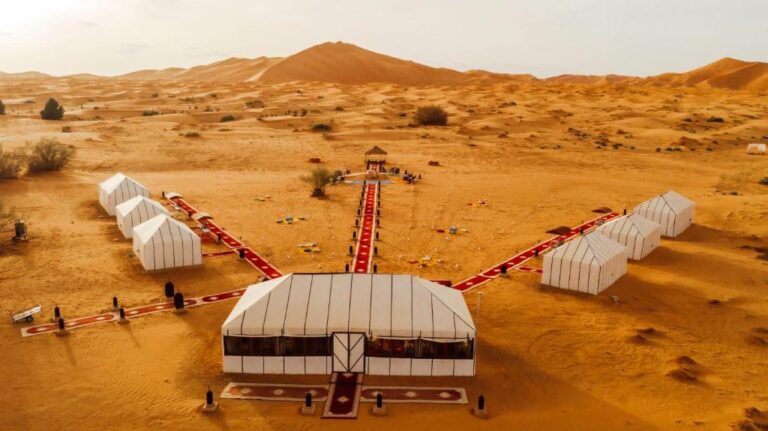
In a city, that may mean a riad with calm interiors and a good location rather than the cheapest option available. In the mountains, it may mean staying somewhere with views and warmth instead of just using the area as a pass-through stop. In the desert, it may mean choosing a camp that feels thoughtful and well-run rather than overly staged.
Good stays create rhythm. They give you places where you can actually rest, reflect, and enjoy where you are.
Leave room in the schedule
Not every hour of a good Morocco trip needs to be programmed.
In fact, too much structure often works against the experience.
Some of the best parts of Morocco are hard to schedule precisely: wandering through a medina, discovering a terrace, lingering over lunch, pausing during a mountain drive, or deciding to have a slower afternoon because the place you are in deserves it.
An intentional trip leaves space for this.
That does not mean poor planning. It means planning intelligently enough that the schedule can breathe.
A full itinerary may look productive on paper, but in practice it can make the trip feel rushed. A slightly lighter itinerary often feels richer because there is room to absorb what is happening around you.
Be thoughtful about what “authentic” means
Many travelers say they want an authentic Morocco experience.
Usually, what they mean is that they do not want something generic or disconnected from the country itself. That is fair. But the word “authentic” can sometimes create unrealistic expectations.
Morocco is not a museum. It is a living country with modern life, tourism, local routines, traditional culture, and global influences all existing at the same time.
Traveling with intention means being open to that complexity.
It means enjoying local craftsmanship, food, architecture, and hospitality without expecting every moment to feel untouched or frozen in time. It means looking for real quality and local character instead of chasing a fantasy version of authenticity.
Often, the most meaningful experiences are the simple ones that belong naturally to the place: a well-run riad, a long meal, a good local guide, a scenic road, a traditional hammam, a conversation, a market, a quiet morning.
Travel respectfully
This should be basic, but it matters.
Intentional travel in Morocco also means understanding that you are moving through places with their own social codes, rhythms, and traditions. You do not need to overcomplicate this. A little awareness goes a long way.
Dress with some respect, especially in more traditional areas.
Ask before taking close-up photos of people.
Be polite but clear in busy tourist zones.
Support local businesses thoughtfully.
Take the time to understand the pace and tone of the place you are in.
Respect does not make the trip less relaxed. It usually makes it smoother.
Let the trip reflect your values
One useful way to think about intentional travel is this: your trip should reflect what matters to you.
If you care about beauty, choose stays and routes that offer it.
If you care about culture, make space for guides, craft, food, and architecture.
If you care about rest, do not build an itinerary that moves every day.
If you care about meaningful experiences, avoid filling the trip with things you feel you “should” do but are not actually interested in.
This sounds obvious, but many people plan around what they think a Morocco trip is supposed to look like.
A better approach is to ask what kind of journey would genuinely feel good, memorable, and worthwhile for you.
That is usually where intention becomes visible.
Accept that you do not need to see everything
A realistic Morocco trip always involves choices.
You will not see everything in one week. Probably not even in two. And that is fine.
Trying to fit too much into a single itinerary does not make the trip more complete. It often makes it thinner.
Intentional travel accepts this early. It chooses a direction and does it well.
Maybe that means Marrakech, the Atlas, and the Sahara.
Maybe it means Fes and the north.
Maybe it means Marrakech and the coast with a slower pace.
The goal is not maximum coverage. The goal is a trip that feels coherent.
What intentional travel looks like in practice
In Morocco, it often looks like this:
- choosing one strong route instead of trying to cross the whole country
- staying at least two nights in key places
- building realistic driving days
- selecting accommodation with character
- leaving room for meals, views, wandering, and rest
- including well-known highlights without letting them dominate the whole trip
- focusing on how the journey feels, not only on what it includes
This is not complicated. It is just more considered.
And usually, it leads to a much better experience.
Final thoughts
The art of traveling Morocco with intention is not about making the trip perfect.
It is about making it thoughtful.
It means understanding that Morocco rewards pace, attention, and good choices. It means resisting the urge to do too much. It means traveling in a way that allows the country to feel layered instead of rushed.
At Riad and Road, we believe the best Morocco journeys are not built around volume. They are built around balance — the right route, the right rhythm, the right stays, and enough space for the country to leave an impression.
Because traveling with intention is not about doing less for the sake of it.
It is about making the experience better.