If you want to experience Morocco properly without feeling like you are constantly in transit, 14 days is one of the best trip lengths.
Two weeks gives you what shorter itineraries often miss: space. Space to enjoy the cities instead of just passing through them. Space to let the road matter. Space to include the desert without rushing in and out. Space to balance culture, scenery, and downtime in a way that feels like a journey rather than a checklist.
Morocco’s official tourism materials consistently present the country through that variety: imperial cities, mountain landscapes, kasbah routes, the Great South, coastal escapes, and distinct regional identities. A good 14-day itinerary finally gives you enough time to combine several of those dimensions without forcing everything into one exhausting loop.
For most first-time travelers, the best 14-day route is:
Marrakech → Atlas Mountains → Aït Ben Haddou / Ouarzazate → Dades / Todra → Merzouga / Sahara → Fes → Chefchaouen → Rabat or Casablanca departure
This works because it follows a natural geographic flow and combines several of Morocco’s most important experiences: the medina atmosphere of Marrakech and Fes, the Atlas crossing, the UNESCO-listed ksar of Aït Ben Haddou, the Sahara, and the northern charm of Chefchaouen.
Why 14 days works so well in Morocco
A week in Morocco gives you a strong introduction. Ten days gives you a satisfying classic route. But two weeks is where the country starts to feel more complete.
That extra time matters for three reasons.
First, Morocco is bigger in practice than it looks on a map. Travel times are real, especially once you include mountain roads and desert distances. Morocco’s official travel information emphasizes regional variety, climate differences, and transport realities, which is why pacing matters so much.
Second, many of Morocco’s highlights are not places you should rush. Marrakech, Fes, and Chefchaouen all reward at least two nights. The desert is much better with time to actually experience it. And the road south is part of the trip, not just a transfer.
Third, 14 days gives you room for contrast. You can enjoy big cities, old medinas, open landscapes, mountain routes, and a slower northern finale without making every day feel overfilled.
Overview of the 14-day itinerary
Day 1–3: Marrakech
Day 4: Atlas Mountains
Day 5: Aït Ben Haddou / Ouarzazate / Skoura
Day 6: Dades Valley or Todra Gorge
Day 7–8: Merzouga and the Sahara
Day 9: Midelt or scenic transfer north
Day 10–11: Fes
Day 12–13: Chefchaouen
Day 14: Rabat or Casablanca for departure
This route is realistic, scenic, and balanced. It avoids the biggest mistake people make with Morocco itineraries: trying to include too many major regions too quickly.
Day 1: Arrive in Marrakech
Marrakech is still the strongest starting point for many Morocco trips. Official tourism resources highlight it through its medina, gardens, souks, and palaces, and UNESCO recognizes the Medina of Marrakesh as a major historic and cultural site.
On arrival day, keep it light. Check into your riad, have dinner nearby, and let the city set the tone. Marrakech works better when it unfolds gradually.
Day 2: Explore Marrakech properly
Give Marrakech a full day.
This is the day for the medina, souks, one or two major landmarks, and time to enjoy the city’s atmosphere rather than turning it into a race between attractions. Marrakech’s appeal is not only what you visit, but the whole sensory rhythm of the place: courtyards, roofs, craft, food, and the contrast between busy streets and quiet interiors.
Day 3: Another day in Marrakech or a soft day trip
With 14 days, you do not need to leave Marrakech immediately.
That extra day is useful. It can be spent enjoying more of the city at a slower pace, or used for a light excursion to the surrounding area. Keeping a third night in Marrakech helps the trip start well instead of feeling rushed from day one.
Day 4: Marrakech to the Atlas Mountains
Instead of treating the Atlas as something you only drive through, use part of your 14-day itinerary to actually stay there.
Morocco’s tourism materials present Atlas destinations as a major part of the country’s appeal, and that makes sense. The mountains offer a needed contrast to the city: cooler air, wider views, village scenery, and a slower rhythm.
A night here makes the trip feel more layered and gives you a much better transition into the south.
Day 5: Atlas crossing and Aït Ben Haddou
This is one of the great travel days in Morocco.
The road south through the High Atlas leads naturally toward Aït Ben Haddou, which UNESCO describes as an outstanding example of a southern Moroccan ksar and a major example of earthen architecture. It is one of the most meaningful and visually striking heritage stops in the country.
After visiting, continue toward Ouarzazate, Skoura, or a nearby stay. Do not try to push too far. In a good 14-day itinerary, this day should feel scenic, not punishing.
Day 6: Dades Valley or Todra Gorge
The classic southern route is stronger when you let this part breathe.
Morocco’s official desert-and-oasis materials highlight places like Skoura, Erfoud, Merzouga, and surrounding routes as part of the wider Great South experience, not just as steps on the way to the dunes.
A night in Dades or near Todra allows you to enjoy that landscape properly. It turns the desert route into a journey instead of a long march toward one headline destination.
Day 7: Arrive in Merzouga
The approach to Merzouga is one of the reasons this itinerary works so well.
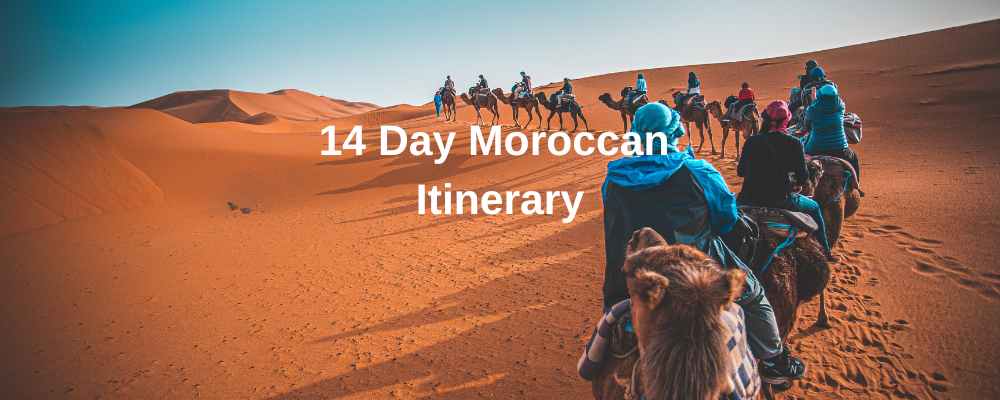
By the time you arrive, the desert feels like a real transition, not an isolated excursion. Morocco’s official tourism site presents the Great South through dune landscapes, bivouacs, camel routes, and broad open space, and that is exactly the kind of experience Merzouga delivers.
Arrive in time for sunset if possible. That makes the first evening count.
Day 8: Full desert day
In a shorter itinerary, travelers often give the Sahara one rushed night. With 14 days, there is no reason to do that.
A second day in the Merzouga area makes the trip noticeably better. It gives you time for sunrise, rest, a slower breakfast, and a more immersive desert experience. The desert should feel like a chapter of the trip, not a quick activity. Official tourism guidance frames the region that way too.
Day 9: Begin the journey north
This is an important transition day.
You can either break the route with an overnight around Midelt or structure the northbound journey based on your transport style. The key point is realism. Even in a 14-day itinerary, this transfer should be respected rather than hidden.
The reason the 14-day version works so well is that it gives you enough time to handle these distances honestly.
Day 10: Arrive in Fes
Fes gives the itinerary a different kind of depth.
Official tourism materials present Fes as one of Morocco’s defining cultural cities, known for its medina, craftsmanship, and imperial heritage. UNESCO also lists the Medina of Fez among Morocco’s major World Heritage sites.
After the wide landscapes of the south, Fes feels dense, historic, and intricate. That contrast is one of the strengths of this route.
Day 11: Full day in Fes
Fes deserves a proper day, ideally with a selective rather than overloaded approach.
Move through the medina, focus on a few meaningful stops, and give yourself time to absorb the city’s atmosphere. Fes is best experienced through depth, not speed. Its reputation as one of Morocco’s key heritage cities is well established in both official tourism and UNESCO materials.
Day 12: Travel to Chefchaouen
Chefchaouen is one of the best additions made possible by a 14-day trip.
Official tourism materials present it not only as visually distinctive, but also as a place of heritage, crafts, and surrounding nature. That is why it works well after Fes: it changes the mood completely.
After the density of imperial cities and the drama of the desert route, Chefchaouen brings a gentler, slower final chapter.
Day 13: Full day in Chefchaouen
A full day here is worth it.
Chefchaouen should not just be a photo stop. The city’s medina, atmosphere, and mountain setting are what make it memorable, and the official tourism framing reflects that broader appeal.
This is one of the places in the itinerary where slowing down adds the most value.
Day 14: Rabat or Casablanca departure
From Chefchaouen, it makes sense to route toward Rabat or Casablanca, depending on flights.
Rabat is a particularly elegant end point because it offers another side of Morocco: a capital city with coastline, monuments, and a more spacious urban feel. Official tourism materials describe it as both cultural and coastal, which makes it a strong final overnight or departure gateway. UNESCO also lists Rabat as “Modern Capital and Historic City: a Shared Heritage.”
If logistics are easier through Casablanca, that is perfectly practical too.
Could you include Essaouira as well?
You could, but it depends on your priorities.
If you add Essaouira to this 14-day route, something else has to give. The most likely cut would be Chefchaouen or one of the extra nights that currently make this itinerary comfortable. Essaouira is absolutely worth visiting, and UNESCO recognizes the Medina of Essaouira as a World Heritage site, but it usually works best in a different 10- to 14-day route built around Marrakech and the Atlantic coast rather than the desert and north.
Who this itinerary is best for
This 14-day itinerary is ideal for travelers who want:
a first trip that feels broad but still coherent, a real overland journey, a proper Sahara chapter, more than one imperial city, and a northern finale.
It is especially strong for couples, first-time visitors, photographers, and travelers who want variety without chaos.
Final thoughts
The best Morocco itinerary for 14 days is not the one that tries to include every famous place in the country.
It is the one that gives you the right mix of city depth, scenic transitions, desert immersion, and time to enjoy each stage properly. For most first-time travelers, that means Marrakech, the Atlas, Aït Ben Haddou, the southern valleys, Merzouga, Fes, and Chefchaouen, with a practical departure through Rabat or Casablanca.
At Riad and Road, that kind of route works because it feels complete without becoming crowded.